I. The Gathering
We gathered around the record player. Some people came later, brought more chairs in to the crowded basement living room. Someone brought snacks. Someone else brought drinks. We complained about the weather. The world order. We introduced ourselves, pronouns, what has made us feel powerful lately. Someone mentioned the gym, being a good teacher, another mentioned their work at the courthouse, helping bring justice to an innocent person. We laughed, got comfortable, and then the needle dropped.
II. The Paradox
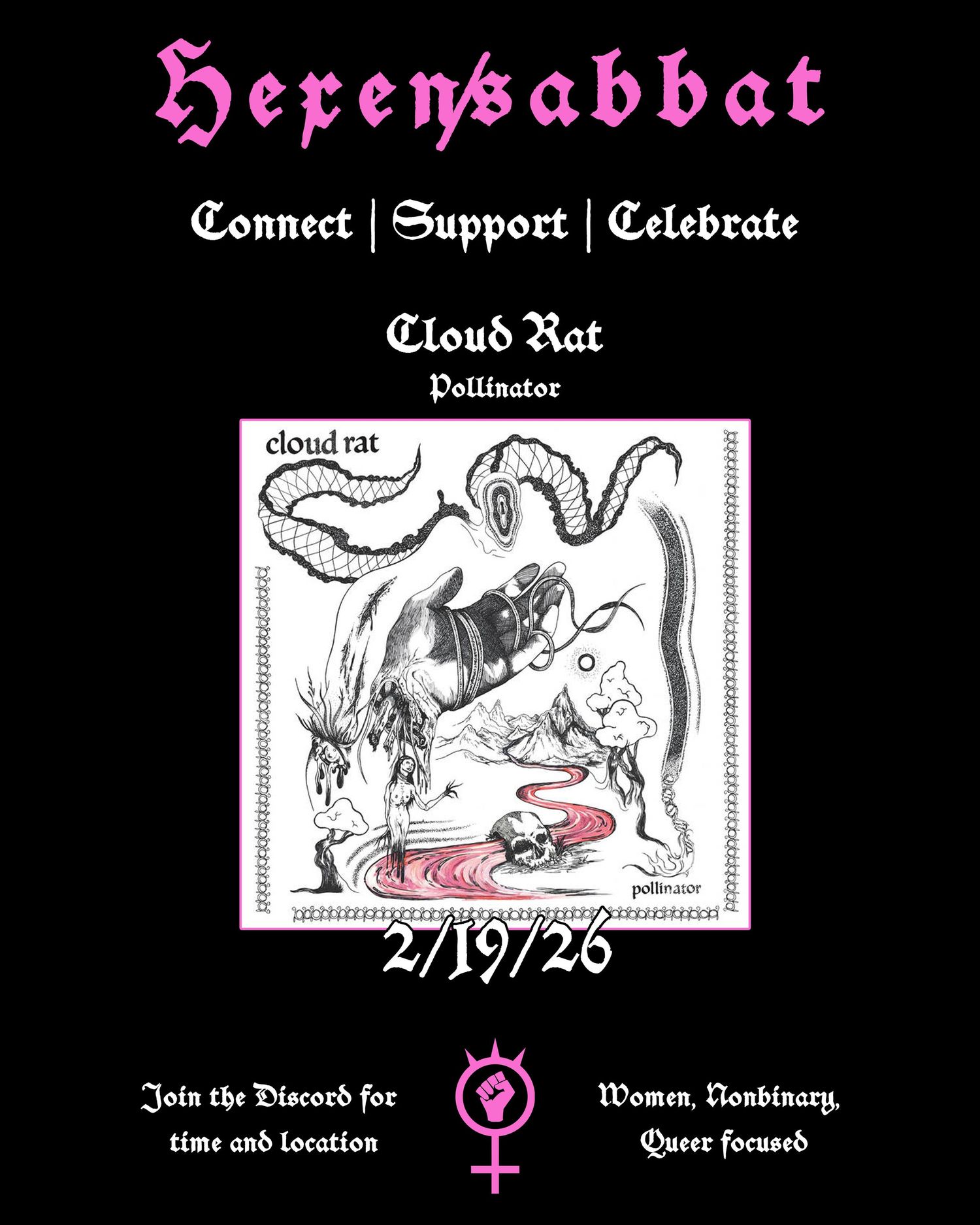
Prior to listening to Cloud Rat's 2019 album, Pollinator, we took time to read an article by Laina Dawes called, *Heavy Metal Feminism*, that she wrote for Hazlitt in 2015. Dawes interviewed, among other people, Kayla Phillips lead singer of (now split-up) grindcore band, Bleed the Pigs. There was (in 2015) and is a call for more inclusivity in such a DIY music scene. Dawes and Phillips lay out clear instances of feeling othered and judged for their gender and race. Dawes says, "there remains great resistance to discuss ongoing sexism, racism, and other issues that can potentially dissuade fans from actively participating in the subculture. 'I don't know why it is so hard for people to understand that not everyone is just like them,' Phillips told me."
We also read an interview with Cloud Rat, conducted by Marika Zorzi for New Noise Magazine back in 2019 when Pollinator was first released. Guitarist Rorik Brooks said in that interview, "I want [our music] to be a more positive, not just fuck-everything-all-the-time, image." And it's an odd tension with the visceral album they put forth. Especially knowing how dog-shit awful the world became shortly after its release.*
The article left me feeling bleak and defeated. Eleven years after the article was published, how is it the heavy metal scene still feels so pervasively white and cis-male? Where are all the non-binary homies? Where are the black and brown folks? The women and femmes who love this music as much as I do? How can we create a more inclusive community?
The interview was confusing. Knowing what I know about the lyrics and the content of the words in Pollinator, it is unclear what it is that could be positive about the album.
III. What We Heard
I learned quickly that many of our members are not regular listeners to grindcore. In fact, I think there was some difficulty connecting to the music. Maybe it was the wall of sound, the insane speed, or moments of Madison's bone-rattling scream over a silent background. I recall one woman saying she really needed more melody and rhythm. Others found the lingering compositions and bright sound immediately compelling. We all landed in different places with the music, but something clicked when we read the lyrics.
I find it endlessly fascinating how Cloud Rat owns all facets of femininity. From the gruesome vocals, highlighting Madison's serious range. To the horror of miscarriage, and body dysphoria. We pieced together a mosaic of lines and images. I explained what I'd heard it's like to experience a miscarriage as we talked about Delayed Grief // Farmhouse Red, and "chain-link dirty dots." Recalling what my friends have told me about the horror of blood and tissue in the loneliest and scariest nights of their lives. The room was silent as we all processed the grief being described in this song.
We talked about The Mad, and each of us saw something in a bizarre kaleidoscope of our humanity reflected back at us, we all acknowledged the shared experience of asking ourselves, "Can you slow your breath? Become softer? Have kindness, and leave it alone?" We all could relate to feeling out of control in this world. Needing to focus on our breath. And not let the sick-fucking world harden us to one another. Rage and disgust come so easily these days, and having kindness is a true means of revolution. I find it comforting knowing that others feel this way, like the bastards are winning when my gut reaction is to be angry and harsh with others, and just how hard it is to remember to breathe and be softer. It's this tenderness and softness that is strength after all.
We lingered on what technology has done to us as we pondered Luminescent Cellar, how easily we, "give my life to strangers and I keep it from the ones I love." As we spent more and more time absorbed in our phones, with strangers on social media, we seemingly get farther and farther away from real-life. We fall down this hole with strangers, and the most precious thing - time spent with our loved ones - goes so quickly. Coming together like this as a collective is difficult for many of us, but it is an act of rebellion against the machines in our hands.
And there were moments of confusion. Someone noted the line, "Great opportunity lies in this state of confusion" and somehow it felt appropriate that not everything in Pollinator's nearly 32 minute brutal epic makes sense, can neatly be tied up with a bow, nor should it be. After all, I'd deeply distrust any artist who asks, "Am I a good person?" and answers definitively. We ain't all good, we are human.
IV. What We Brought
Cloud Rat shows us alternatives to what the patriarchy tells us it means to be feminine. We see the harshness our lived experiences held up to us in the power of the drums relentlessness. We feel our anger reflected back to us through Madison's vocals. The band's visceral sound rejects sanitized femininity and embraces gory images of miscarriage, sagging flesh, morphing skin. Obliterating the palatable. Being a woman in this world is gruesome. Cloud Rat doesn't let us forget it. And everyone at Hexensabbat brought something of themselves: the hell that is body dysphoria, the hiding of oneself to appease family, the nightmare of mental illness in bleak times. This is the reality of our identity that we refuse to sanitize for others' comfort.
V. What We're Taking With Us
As the end of the evening drew near, someone asked, "I genuinely am curious, what is positive about this album?" They were thinking about the interview, and I saw the confusion after reading the lyrics. But, I think we must consider the larger picture. Yes, there is something positive in the music itself. Despite not traditionally seeing ourselves in these spaces, there's catharsis in letting out the rage, disgust, and fear. And, there's true brightness in the instrumentality of Pollinator, fusing melodic moments with powerviolence, and back again. There's something to be said about how those lyrics all speak to us in different ways. A smattering of our own humanity - it's confusing and relatable. But more importantly, here we are, at our monthly Hexensabbat, gathered in community, cross pollinating ideas about what it means to be a feminist in this bleak world. Sharing snacks and banging heads. Stepping more fully into our shared understanding of resistance to patriarchy through gnarly screams and mind-bending lyrics. Collectively, we heard Cloud Rat's call to "Take up space." Here, the fuck, we are.
___
* In case you missed it, the world took a massive nose-dive in 2019. This is not an exhaustive list, but some major events include: a global pandemic with over a million lives lost in the US alone, loss of bodily autonomy with Roe v. Wade being overturned, escalating police brutality and protest of racial violence, Russia invading Ukraine, the Uvalde school mass murder, gender-affirming care was criminalized in multiple states, and a genocide in Gaza.
-V